
REGISTRY // 1RL-F1R3-0104Reanimated-Paddock-Resident
Pyroraptor
[ PIE-roh-RAP-tor ]Meaning: “Olympic Fire Thief”
Late Cretaceous (~70–72 Million Years Ago)Provence Region, Southern France (La Boucharde Formation)
SRC // Consortium Bio-Imaging // Sector C
LOG 1 / 3
FIELD OBSERVATION // RANGER MILESTHREAT: Class-III-Hazardous
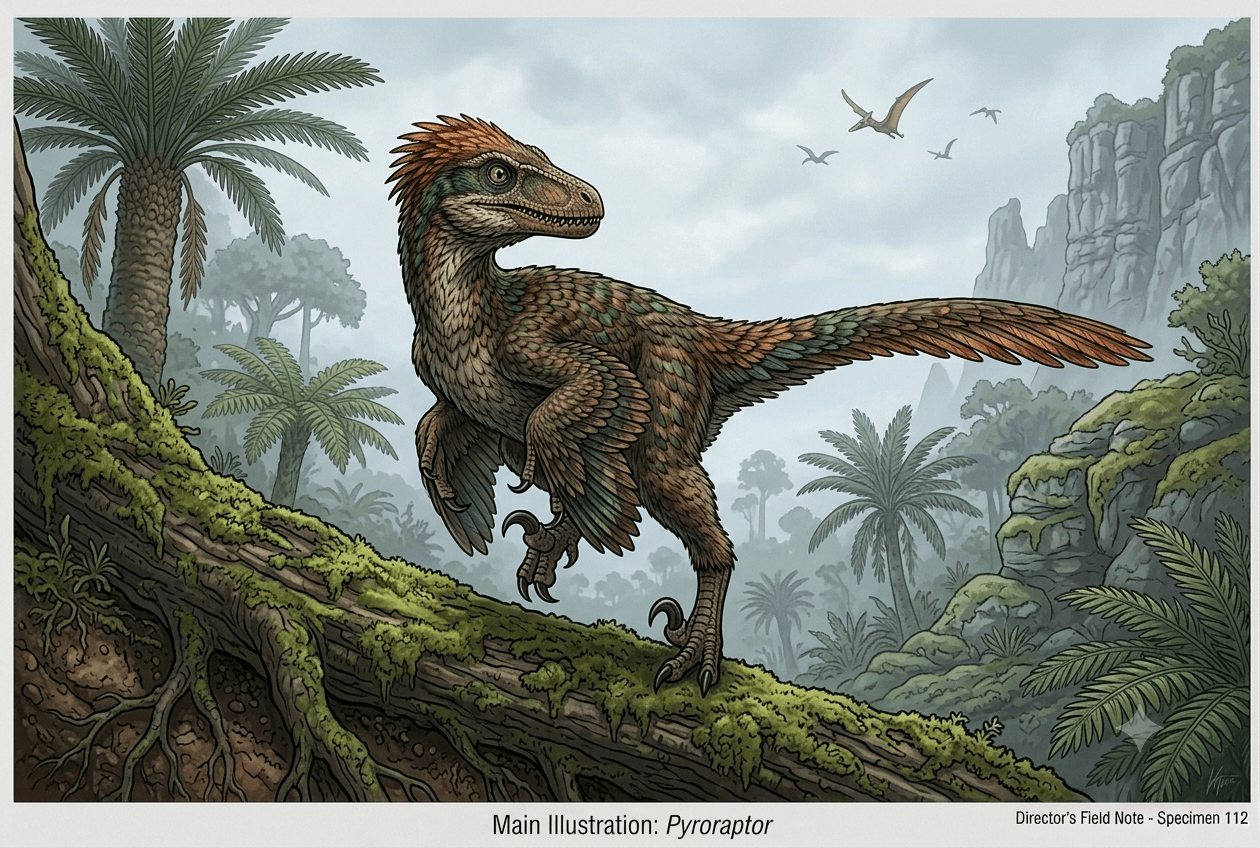
Do not underestimate this theropod based on its size. Standing under three feet tall at the hip, the sickle claw on the second toe functions as an anchor mechanism rather than a slashing tool—it tackles and pins prey while using its pennaceous forearm plumage for aerodynamic stabilization. Containment fencing requires a minimum 12-foot ground anchor; they have demonstrated pack coordination and attempt to dig beneath the foundations during heavy rainfall.
Species:P. olympius
Classification:Dinosauria, Saurischia, Theropoda, Dromaeosauridae, Eudromaeosauria
PALEONTOLOGICAL FACTSFIELD_DATA
- What kind of dinosaur was it?A small, feathered, highly agile carnivorous dromaeosaurid (raptor).
- When did it live?Late Cretaceous (Late Campanian to Early Maastrichtian, ~70–72 Million Years Ago).
- Where was it found?Discovered in 1992 after a forest fire exposed fossilized teeth, claw bones, and vertebrae in Provence, France.
- How big was it?Roughly 8 feet long (2.5 meters) nose-to-tail, but only about 2.5 feet tall at the hip and weighing around 65–70 lbs.
BIOMECHANICS & ADAPTATIONS
Armed with a curved 2.5-inch sickle ungual on each hind foot, stiffened caudal rods running down its tail for high-speed dynamic cornering, and lightweight pneumatic bones that allowed for explosive sprint acceleration.
ACADEMIC SOURCES & EXCAVATION RECORDS
> Allain & Taquet (2000) - 'A new dromaeosaurid from the Late Cretaceous of southern France'
> Muséum National d'Histoire Naturelle, Paris Research Archives