
REGISTRY // 1RL-5TUP-0144Reanimated-Paddock-Resident
Stupendemys
[ stoo-PEN-deh-mees ]Meaning: “Stupendous Turtle”
Middle to Late MioceneNorthern South America: Venezuela (Urumaco), Colombia (Tatacoa Desert), Brazil and Peru
SRC // Consortium Bio-Imaging // Leviathan Lagoon
LOG 1 / 2
FIELD OBSERVATION // RANGER MILESTHREAT: Class-II-Shell-Hazard
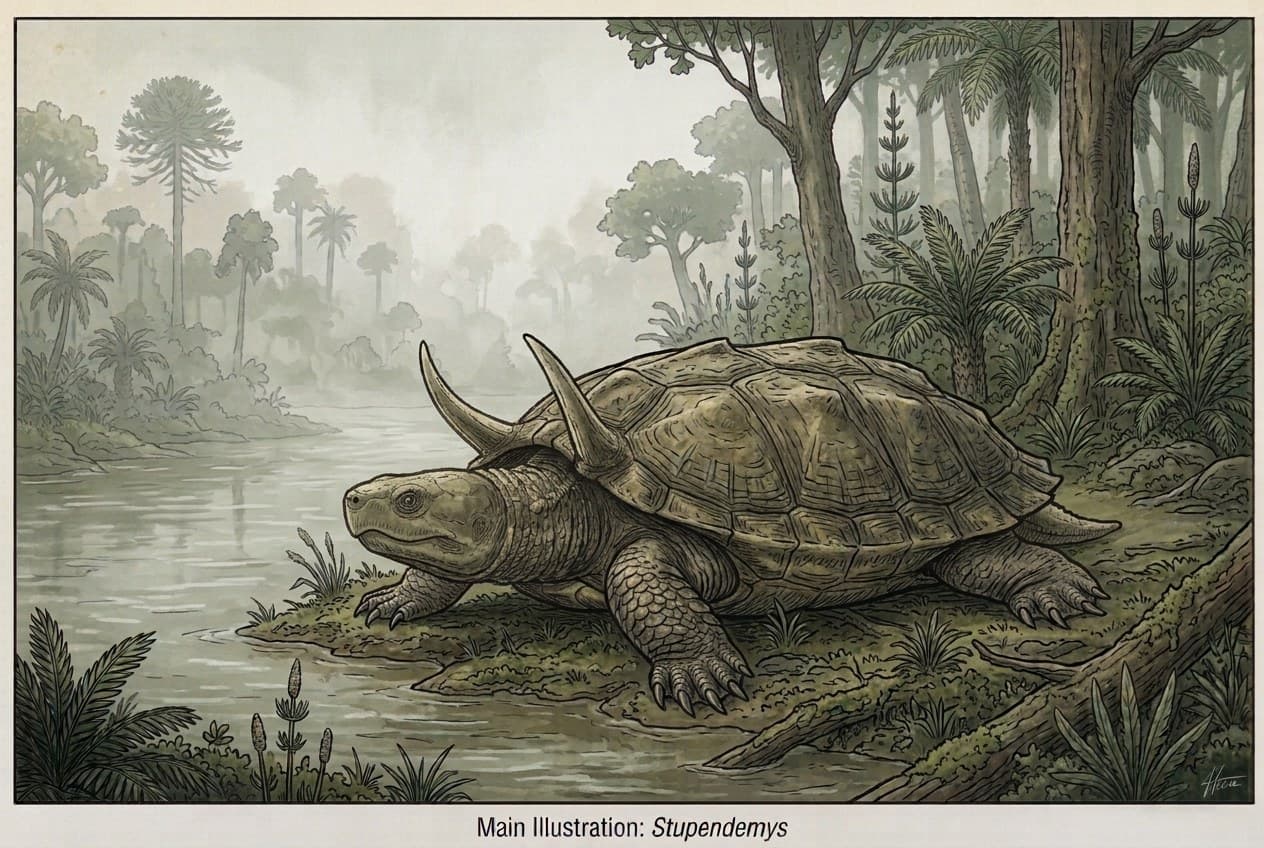
Stupendemys lived in rivers and wetlands and had a huge, heavy shell. Scientists think males had horn-like points at the front of the shell, and its diet may have been broader than just meat, possibly including shellfish and fruit. Here it lives in a freshwater aquarium in the Leviathan Lagoon area. Safety rule: never lean over the water's edge, because the animal is very large and heavy.
Species:S. geographica
Classification:Testudines, Pleurodira, Podocnemididae (a side-necked turtle, not a dinosaur)
PALEONTOLOGICAL FACTSFIELD_DATA
- What kind of prehistoric animal was it?A giant freshwater turtle, a reptile (not a dinosaur).
- When did it live?During the middle to late Miocene.
- Where was it found?In northern South America: Venezuela, Colombia, Brazil and Peru.
- How big was it?The largest shell found was about 8 to 9 feet (2.4 to 2.86 meters) long, the largest shell reported for any turtle.
BIOMECHANICS & ADAPTATIONS
A huge, heavy shell, with horn-like points on the front of the shell in males.
ACADEMIC SOURCES & EXCAVATION RECORDS
> Cadena, E.-A. et al. (2020) - 'The anatomy, paleobiology, and evolutionary relationships of the largest extinct side-necked turtle', Science Advances 6(7): eaay4593, doi:10.1126/sciadv.aay4593 (abstract and body text read via the open PDF 2026-11-15; era, places, size, horn hypothesis, diet)
> Cadena, E.-A. et al. (2021) - Heliyon 7(12), doi:10.1016/j.heliyon.2021.e08591 (source of the fossil photo)
> Wood, R. C. (1976) - 'Stupendemys geographicus, the world's largest turtle', Breviora 436 (original description; the genus name alludes to the turtle's astonishing size; excerpt read via search result 2026-11-15)
> Cadena, E.-A. et al. (2021) uses the spelling 'Stupendemys geographica' in its abstract; Wood (1976) named it 'geographicus', and the ending was corrected to agree with the feminine genus name