
REGISTRY // 1RL-PL3S-0210Reanimated-Paddock-Resident
Plesiosaurus
[ PLEE-see-oh-SAW-rus ]Meaning: “Near Lizard”
Early Jurassic (Sinemurian, about 197-192 Million Years Ago)Lyme Regis, Dorset, southern England, UK (Blue Lias)
SRC // Consortium Bio-Imaging // Leviathan Lagoon
LOG 1 / 3
FIELD OBSERVATION // RANGER MILESTHREAT: Class-III-Aquatic-Hazard
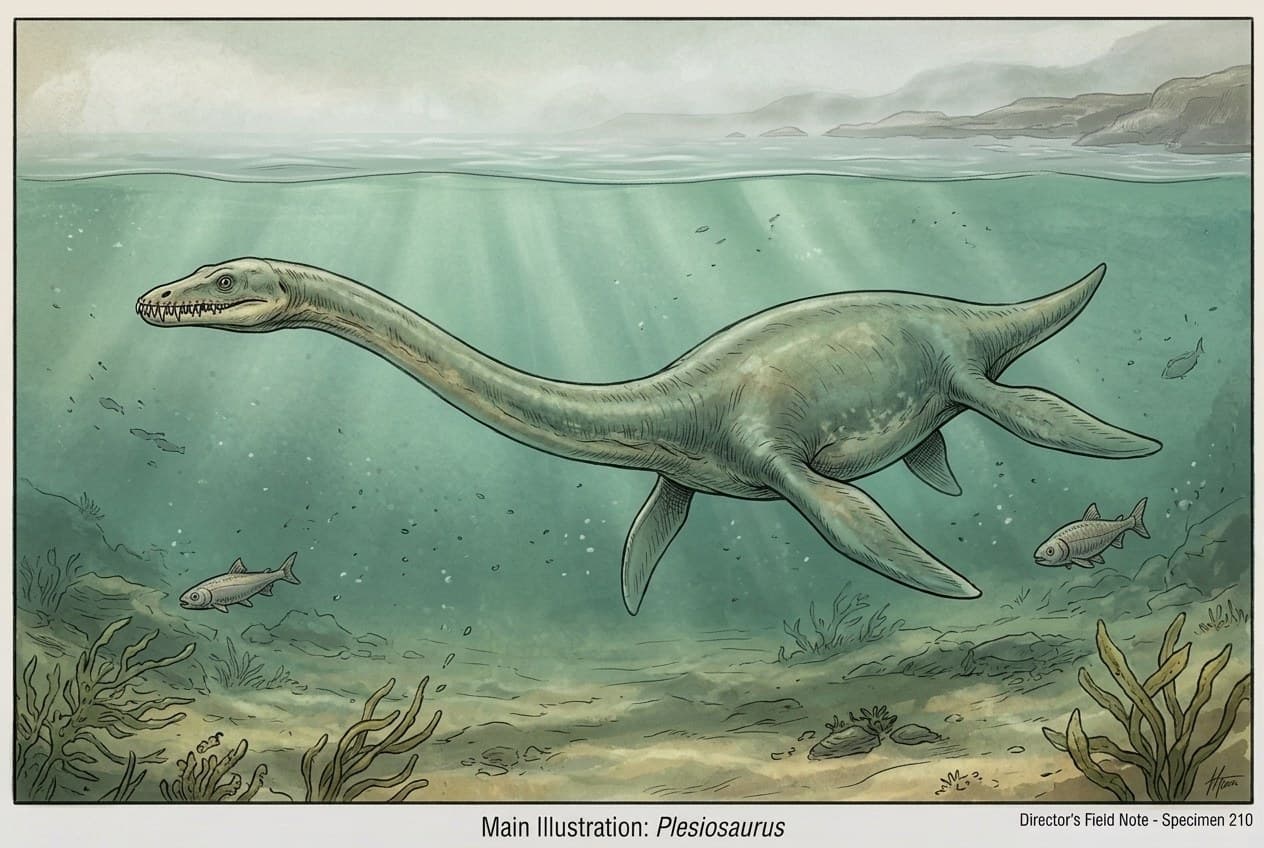
Plesiosaurus swam in the sea using four paddle-shaped flippers, and it had a long neck with a small head. Some scientists think it ate fish and squid. Safety rule: stay back from the water's edge, because a long neck can reach farther than you think.
Species:P. dolichodeirus
Classification:Sauropterygia, Plesiosauria (a marine reptile, not a dinosaur)
PALEONTOLOGICAL FACTSFIELD_DATA
- What kind of prehistoric animal was it?A long-necked marine reptile (not a dinosaur).
- When did it live?During the Early Jurassic, in the Sinemurian age, about 197 to 192 million years ago.
- Where was it found?At Lyme Regis in Dorset, southern England.
- How big was it?About 10 to 11.5 feet long (3 to 3.5 meters). Sources vary.
BIOMECHANICS & ADAPTATIONS
A long neck with a small head and four paddle-shaped flippers for swimming.
ACADEMIC SOURCES & EXCAVATION RECORDS
> Geological Society of London - 'Plesiosaurus dolichodeirus, found 1823', geolsoc.org.uk online exhibition (opened 2026-11-15; Mary Anning, date)
> 'The most wonderful wonder ever discovered: Mary Anning's 1823 Plesiosaurus', Earth Sciences History 44(1): 29-50, doi:10.17704/1944-6187-44.1.29 (abstract read via search result 2026-11-15; 10 December 1823, Lyme Regis)
> Wikipedia and mirrors - 'Plesiosaurus' (read via search results 2026-11-15; name meaning, length, Sinemurian age; not primary)