
REGISTRY // 1RL-TR1C-0143Reanimated-Paddock-Resident
Triceratops
[ tri-SERRA-tops ]Meaning: “Three-Horned Face”
Late Cretaceous (about 68-66 Million Years Ago)Western North America, USA (most found in the Hell Creek Formation of Montana, Wyoming and the Dakotas)
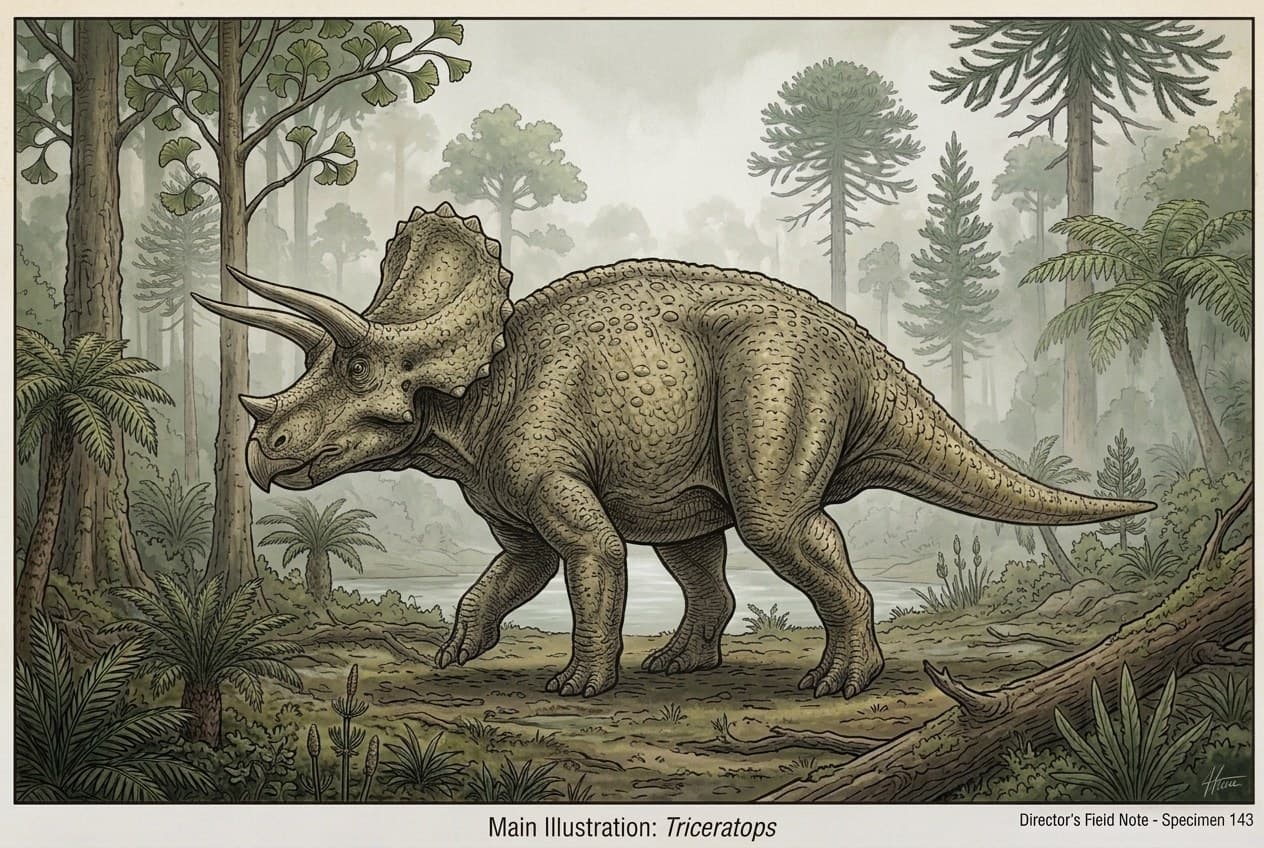
SRC // Consortium Bio-Imaging // Sector H
LOG 1 / 3
FIELD OBSERVATION // RANGER MILESTHREAT: Class-III-Horned-Hazard
Triceratops walked on four strong legs and had a bony frill and three horns on its head. It ate plants, and some scientists think it used its horns to defend itself and to show off. Safety rule: never stand in front of the horns, and keep to the path around the Herbivore Grazing Paddock.
Species:T. horridus
Classification:Dinosauria, Ornithischia, Ceratopsidae, Chasmosaurinae
PALEONTOLOGICAL FACTSFIELD_DATA
- What kind of prehistoric animal was it?A horned, plant-eating dinosaur.
- When did it live?During the Late Cretaceous, about 68 to 66 million years ago.
- Where was it found?In western North America, in the USA. Most fossils come from the Hell Creek Formation.
- How big was it?About 26 to 30 feet long (8 to 9 meters). The Natural History Museum, London, gives 9.0 meters.
BIOMECHANICS & ADAPTATIONS
A bony frill behind the head, three horns, and four strong legs.
ACADEMIC SOURCES & EXCAVATION RECORDS
> Natural History Museum, London - Dino Directory, 'Triceratops', nhm.ac.uk/discover/dino-directory/Triceratops.html (opened 2026-11-15; name meaning, pronunciation, age, length, weight)
> HowStuffWorks - 'Triceratops', science.howstuffworks.com/triceratops.htm (read via search result 2026-11-15; Marsh 1889 name, Hell Creek fossils)