
REGISTRY // 1RL-B0NK-0001Ontogenetic-Review-Paddock-Resident
Stygimoloch
[ STIJ-eh-MOLL-uk ]Meaning: “Demon from the River Styx”
Late Cretaceous (~66–68 Million Years Ago)Hell Creek Formation, Montana & Wyoming, USA
SRC // Consortium Bio-Imaging // Sector H
LOG 1 / 3
FIELD OBSERVATION // RANGER MILESTHREAT: Class-II-Charge-Hazard
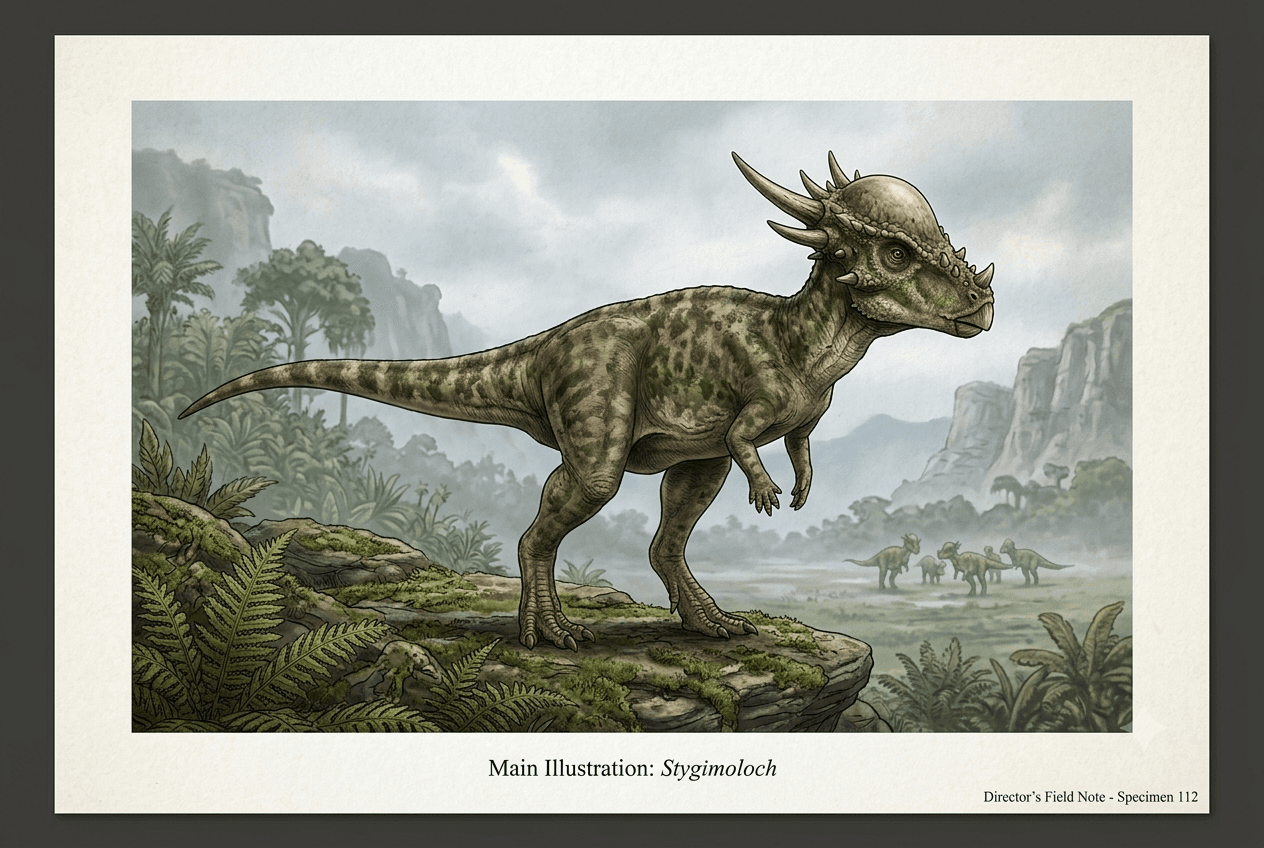
Adolescent pachycephalosaurids present a kinetic impact challenge. The cranial dome consists of dense, vascular fibrolamellar bone surrounded by a crown of backward-pointing horns up to six inches long. Charge acceleration reaches peak velocity within ten strides. Feeding alleys are reinforced with heavy hydraulic damping bumpers; while the skull is engineered to dissipate massive impacts during dominance jousts, repeated strikes will rapidly fatigue standard chain fencing.
Species:S. spinifer (likely juvenile P. wyomingensis)
Classification:Dinosauria, Ornithischia, Marginocephalia, Pachycephalosauria, Pachycephalosauridae
PALEONTOLOGICAL FACTSFIELD_DATA
- What kind of dinosaur was it?Bipedal, dome-skulled herbivore widely classified by paleontologists as a sub-adult growth stage of Pachycephalosaurus.
- When did it live?Late Cretaceous (Maastrichtian stage, ~66–68 Million Years Ago).
- Where was it found?Hell Creek Formation and Lance Formation across Montana, Wyoming, and South Dakota, USA.
- How big was it?Roughly 10 feet long (3 meters) and weighing approximately 450–500 lbs.
BIOMECHANICS & ADAPTATIONS
Armed with a thick, bone-spiked cranial dome, strong bipedal hindlimbs built for explosive sprint bursts, and heavy neck musculature adapted to absorb direct kinetic collisions.
ACADEMIC SOURCES & EXCAVATION RECORDS
> Galton & Sues (1983) - 'New data on pachycephalosaurid dinosaurs from North America'
> Horner & Goodwin (2009) - 'Extreme Cranial Ontogeny in the Upper Cretaceous Dinosaur Pachycephalosaurus'
> Museum of the Rockies Paleontology Research Archives