
REGISTRY // 1RL-T4P3-0118Reanimated-Paddock-Resident
Tapejara
[ tah-peh-JAH-rah ]Meaning: “Lord of the Path”
Early Cretaceous (Aptian–Albian)Romualdo Member, Santana Formation, Araripe Basin, Ceará, northeastern Brazil
SRC // Consortium Bio-Imaging // Aviary Spire
LOG 1 / 2
FIELD OBSERVATION // RANGER MILESTHREAT: Class-II-Aerial-Hazard
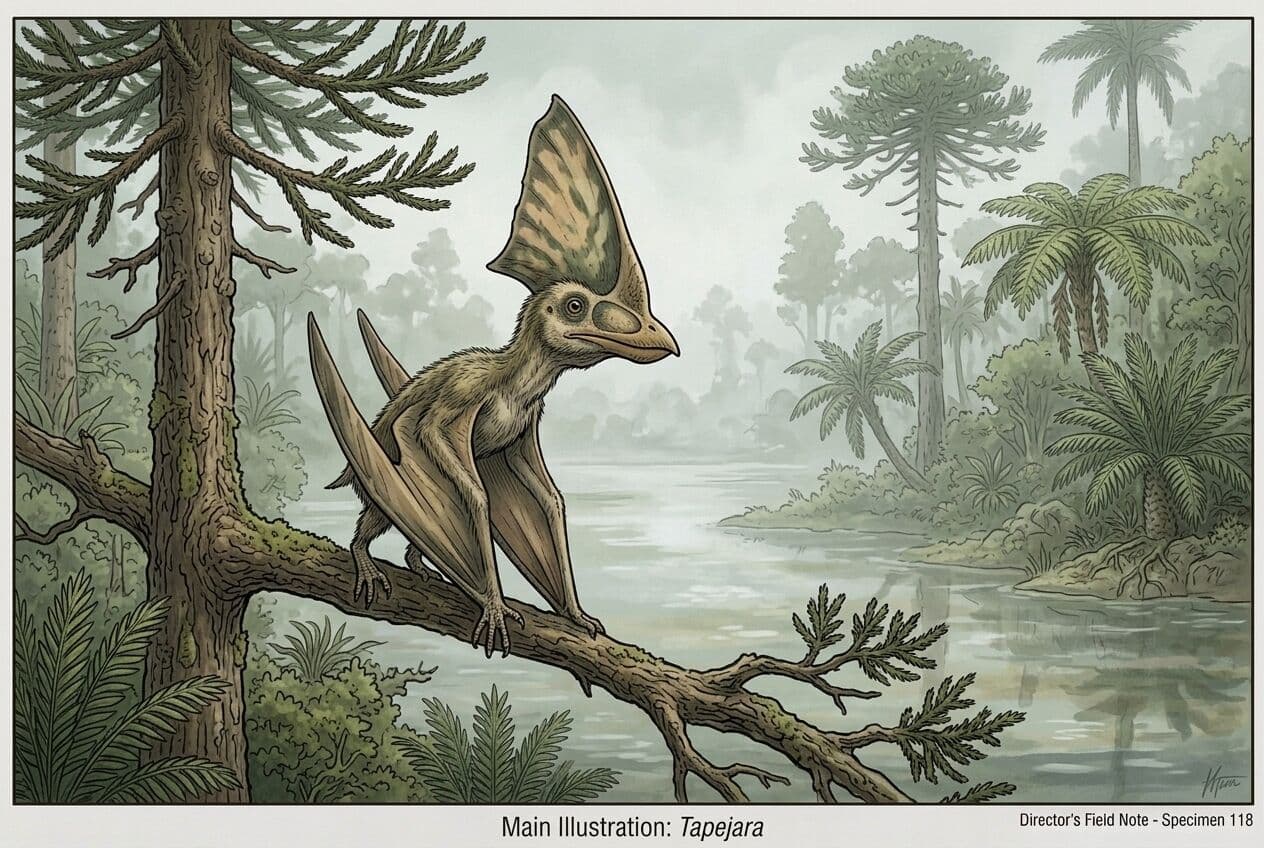
Tapejara was a small pterosaur. A smaller individual had a wingspan of about 4 feet (1.23 to 1.3 meters), and a larger one had wing bones about 1.3 times as long. It had a tall crest on its snout and a bony spike pointing backward from its head. Its fossils come from Brazil. Stay on the path and never reach toward a Tapejara's perch.
Species:T. wellnhoferi
Classification:Pterosauria, Pterodactyloidea, Azhdarchoidea, Tapejaridae
PALEONTOLOGICAL FACTSFIELD_DATA
- What kind of prehistoric animal was it?A small flying reptile called a pterosaur (not a dinosaur), from the family Tapejaridae.
- When did it live?During the Early Cretaceous, in the Aptian to Albian ages.
- Where was it found?In Brazil, in the Romualdo Member of the Santana Formation in the Araripe Basin, Ceará.
- How big was it?The smaller known individual had a wingspan of about 1.23 to 1.3 meters (4 feet). A larger individual had wing bones about 1.3 times as long.
BIOMECHANICS & ADAPTATIONS
A tall crest on the snout and a bony projection reaching backward from the head.
ACADEMIC SOURCES & EXCAVATION RECORDS
> Eck, K., Elgin, R. A. & Frey, E. (2011) - 'On the osteology of Tapejara wellnhoferi Kellner 1989', Swiss Journal of Palaeontology 130(2): 277-296, doi:10.1007/s13358-011-0024-5 (opened 2026-11-01; used for size, age and locality)
> Kellner, A. W. A. (1989) - original description, Anais da Academia Brasileira de Ciências 61(4): 439-446 (not opened)
> Wikipedia - 'Tapejara wellnhoferi' (used only for the name's meaning, which no primary source opened here states; checked 2026-11-01)