
REGISTRY // 1RL-QU3T-0163Reanimated-Paddock-Resident
Quetzalcoatlus
[ ket-sul-koh-AT-lus ]Meaning: “Feathered Serpent”
Late Cretaceous (late Maastrichtian, just before the end of the Cretaceous)Javelina and Black Peaks formations, Big Bend National Park, Texas, USA
SRC // Consortium Bio-Imaging // Aviary Spire
LOG 1 / 3
FIELD OBSERVATION // RANGER MILESTHREAT: Class-II-Aerial-Hazard
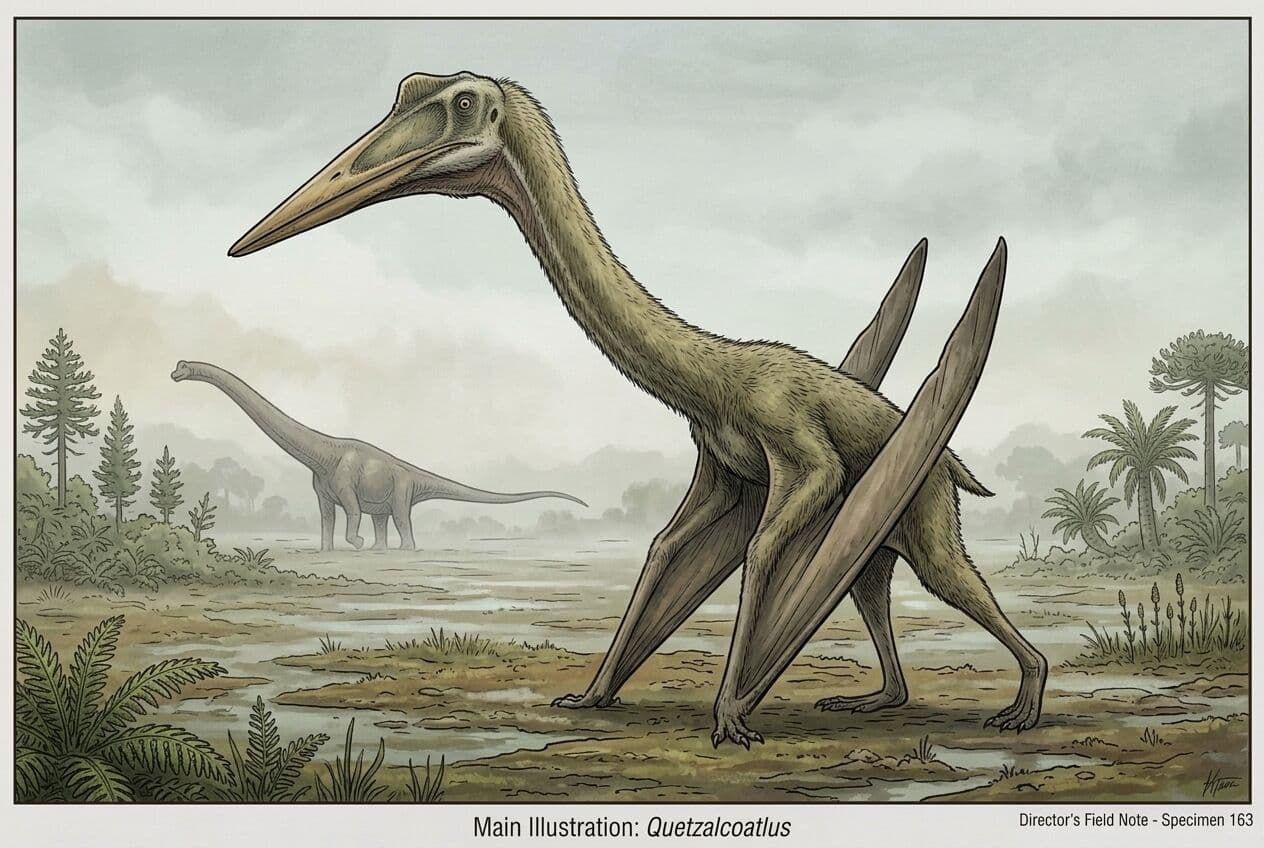
Quetzalcoatlus was a giant pterosaur, with a wingspan of about 10 meters (33 feet) in the latest studies. Scientists think it walked well on the ground on all four limbs and spent much of its time foraging there. One study proposes that it launched into the air from a standing crouch, vaulting off its strong front limbs, a bit like a vampire bat. Stay well back from the landing area, because its wings are huge.
Species:Q. northropi
Classification:Pterosauria, Pterodactyloidea, Azhdarchoidea, Azhdarchidae
PALEONTOLOGICAL FACTSFIELD_DATA
- What kind of prehistoric animal was it?A giant flying reptile called a pterosaur (not a dinosaur), from the family Azhdarchidae.
- When did it live?At the very end of the Cretaceous, in the late Maastrichtian age. The first fossil lay about 1.5 meters below the layer that marks the end of the Cretaceous.
- Where was it found?In Big Bend National Park, Texas, USA. Douglas Lawson found the first fossil in 1971 while doing his master's research.
- How big was it?Published wingspan estimates have ranged from 5.2 to 25.8 meters, and newer ones settle near 10 meters (33 feet). One study estimates a weight of about 200 to 250 kilograms.
BIOMECHANICS & ADAPTATIONS
Enormous wings, short padded feet and long limbs held under the body for walking, and strong front limbs that one study says launched it from a four-legged crouch.
ACADEMIC SOURCES & EXCAVATION RECORDS
> Andres, B. & Langston, W. Jr. (2021) - 'Morphology and taxonomy of Quetzalcoatlus Lawson 1975', Journal of Vertebrate Paleontology 41(sp1), doi:10.1080/02724634.2021.1907587 (opened 2026-11-01; used for discovery, age, formations, etymology, wingspan range and classification)
> Witton, M. P. & Habib, M. B. (2010) - 'On the size and flight diversity of giant pterosaurs...', PLoS ONE 5(11): e13982 (opened 2026-11-01 via PMC; used for the 10-11 m wingspan, 200-250 kg mass, launch idea and ground foraging)
> Lawson, D. A. (1975) - original description, Science (not opened)