
REGISTRY // 1RL-PT3R-0215Reanimated-Paddock-Resident
Pteranodon
[ teh-RAN-oh-don ]Meaning: “Wing Without Teeth”
Late Cretaceous (about 86-84 Million Years Ago)Central North America (Niobrara Formation, western Kansas)
SRC // Consortium Bio-Imaging // Aviary Spire
LOG 1 / 3
FIELD OBSERVATION // RANGER MILESTHREAT: Class-II-Aerial-Hazard
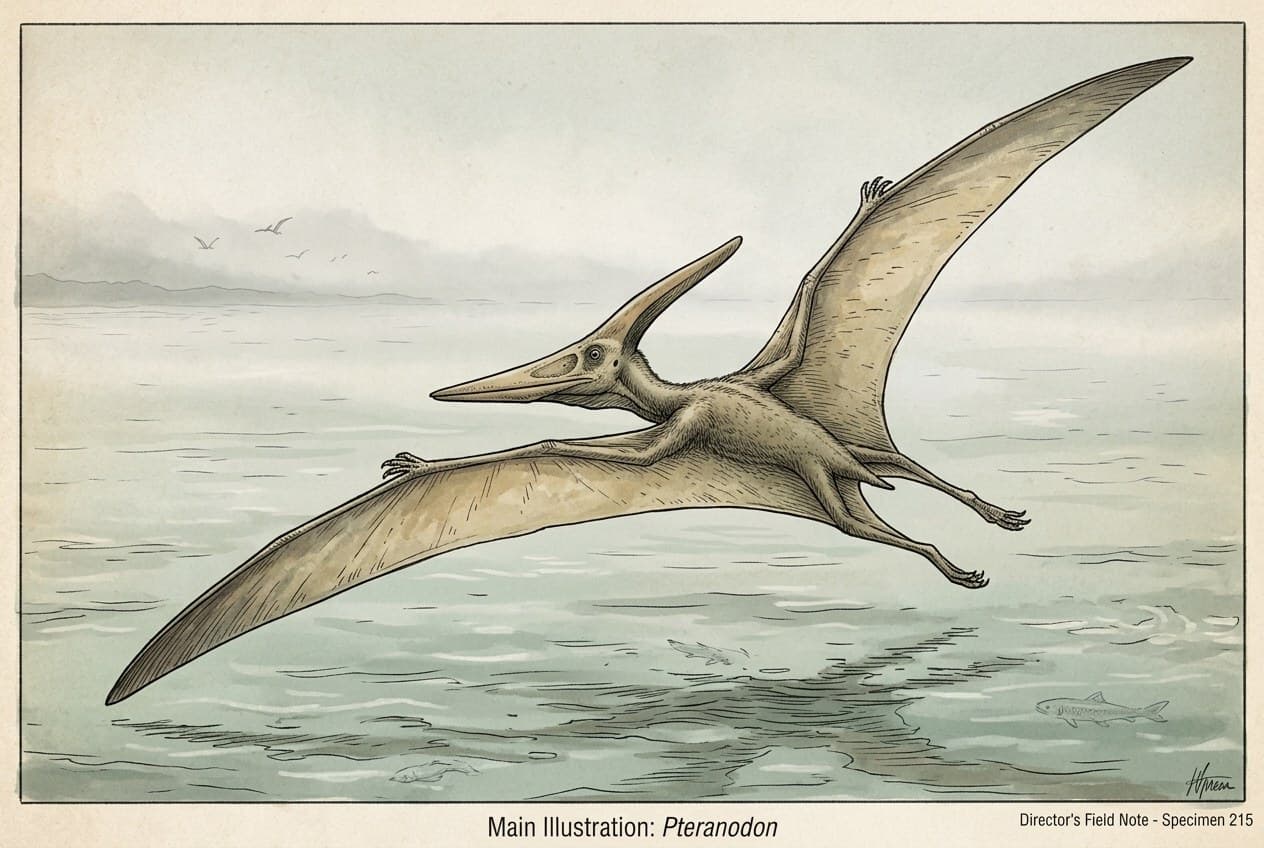
Pteranodon soared over the sea on very long, narrow wings and had a long, toothless beak. Scientists think it ate fish. Safety rule: stay under the dome's covered walkway, and never wave food in the air.
Species:P. longiceps
Classification:Pterosauria, Pterodactyloidea, Pteranodontidae (a flying reptile, not a dinosaur)
PALEONTOLOGICAL FACTSFIELD_DATA
- What kind of prehistoric animal was it?A pterosaur, a flying reptile (not a dinosaur).
- When did it live?During the Late Cretaceous, about 86 to 84 million years ago.
- Where was it found?In central North America, in the Niobrara Formation of western Kansas.
- How big was it?Adult males averaged a wingspan of about 18 feet (5.6 meters), the largest about 20 feet (6.25 meters). Females were smaller, about 12 feet (3.8 meters).
BIOMECHANICS & ADAPTATIONS
Very long, narrow wings, a long toothless beak and, in males, a long pointed crest on the head.
ACADEMIC SOURCES & EXCAVATION RECORDS
> Bennett, S. C. (1994) - taxonomy and systematics of Pteranodon, Occasional Papers of the Museum of Natural History, University of Kansas (excerpt read via search result 2026-11-15; Smoky Hill Chalk, Niobrara Formation, Kansas)
> pteros.com - 'Pteranodon', pteros.com/pterosaurs/pteranodon (read via search result 2026-11-15; diet, crest)
> Wikipedia and mirrors - 'Pteranodon' (read via search results 2026-11-15; name meaning, age and wingspan figures; not primary)